
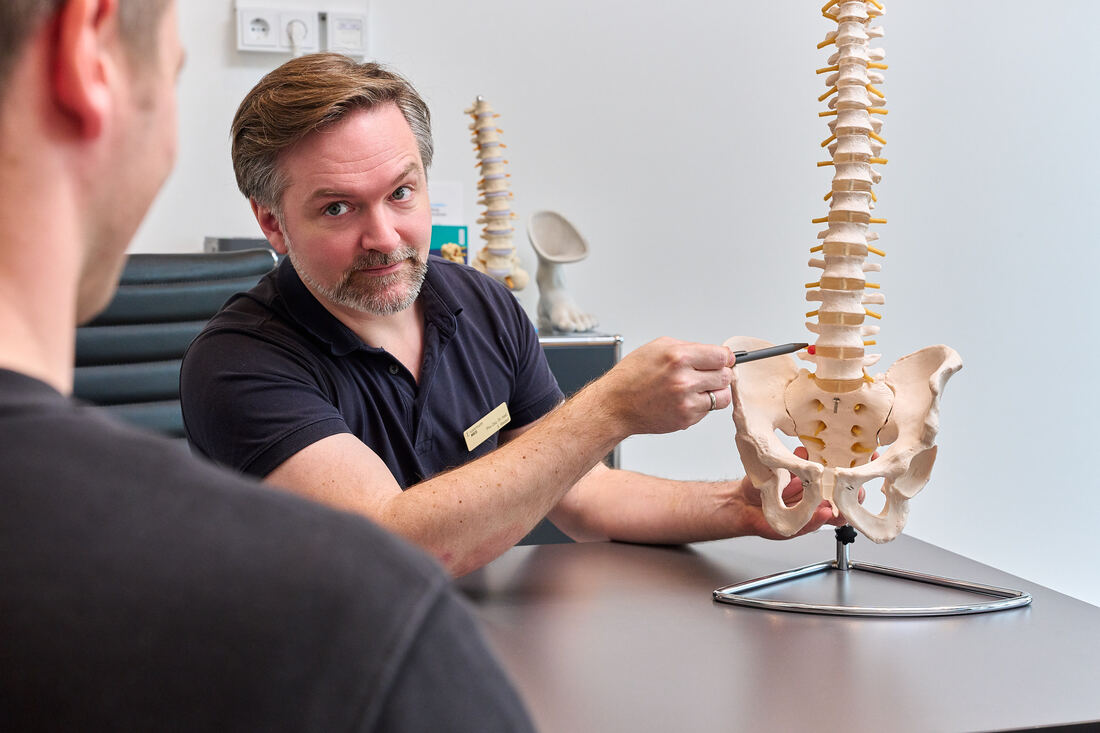
A hip specialist determines whether groin and hip pain comes from the joint itself, from tendons and bursae, from the pelvis or from the spine. At spectrum MED in Munich we combine joint-preserving therapy with many years of experience in minimally invasive hip replacement. The decision for a hip replacement is never made because of an X-ray, but because of your symptoms.
At a glance
- Hip arthritis, hip impingement, labral tear, bursitis
- Distinguishing hip pain from back, SI joint and groin pain
- Hyaluronic acid, shockwave, physiotherapy and muscle building
- Hip replacement via muscle-sparing approaches
- Independent second opinion before an artificial hip joint
Typical hip symptoms
- Groin pain when getting up and start-up pain after sitting
- Difficulty tying shoes or getting into a car
- Pain on the outside of the hip when lying down
- Limping and a shrinking walking distance
- Pain at night
Not all groin pain comes from the hip: The lumbar spine, the sacroiliac joint, Pubic inflammation (osteitis pubis) or a trapped skin nerve (Meralgia paraesthetica) can cause similar pain. We always start by distinguishing these causes.
Conditions
- 1Hip socket (acetabulum)
- 2Femoral head with articular cartilage
- 3Artificial socket
- 4Artificial head
- 5Prosthetic stem in the thigh bone
- Hip osteoarthritis (coxarthrosis)
- Hip impingement (conflict between femoral head and socket) and labral tears
- Avascular necrosis of the femoral head and hip dysplasia
- Bursitis and tendon irritation at the greater trochanter
- Groin pain in athletes
Treatment without surgery
- 1UnderstandConsultation, examination, imaging, diagnostic injection if needed
- 2StrengthenPhysiotherapy, training, medication, load management
- 3Targeted treatmentInjections, radiofrequency, shockwave, regenerative procedures
- 4Surgeryonly when necessary – as minimally invasive as possible
Physiotherapy with targeted strengthening of the gluteal and hip muscles, load management, medication, ultrasound-guided injections, hyaluronic acid for arthritis and shockwave therapy for tendon insertion problems. This often allows joint replacement to be postponed for years.
Hip replacement: when and how?
When pain and restricted mobility dominate daily life and conservative treatment has been exhausted, the artificial hip joint is one of the most successful operations in medicine. We implant hip replacements via muscle-sparing, minimally invasive approaches ; mobilisation usually begins on the day of surgery. Details on the procedure and rehabilitation under Hip replacement.
Frequently asked questions
- How do I recognise hip arthritis?
- Typical signs are groin pain when starting to move, decreasing rotation (e.g. when tying shoes) and later pain at rest and at night. The diagnosis is confirmed by examination and X-ray.
- How long does a hip replacement last?
- Many modern hip replacements last 20 years or longer. Bone quality, weight and activity influence their lifespan.
- Am I too young for a hip replacement?
- It is not age that decides, but symptoms, findings and quality of life. In younger patients we examine joint-preserving alternatives particularly carefully.
- Where is the practice?
- The practice is located in Munich's old town at Sendlinger Straße 37, between Sendlinger Tor (U1, U2, U3, U6, tram) and Marienplatz (S-Bahn, U3, U6) – each just a few minutes' walk away.
Your doctors for this topic




Updated: November 2026 · spectrum MED practice, Sendlinger Straße 37, Munich. This article does not replace a medical examination.