
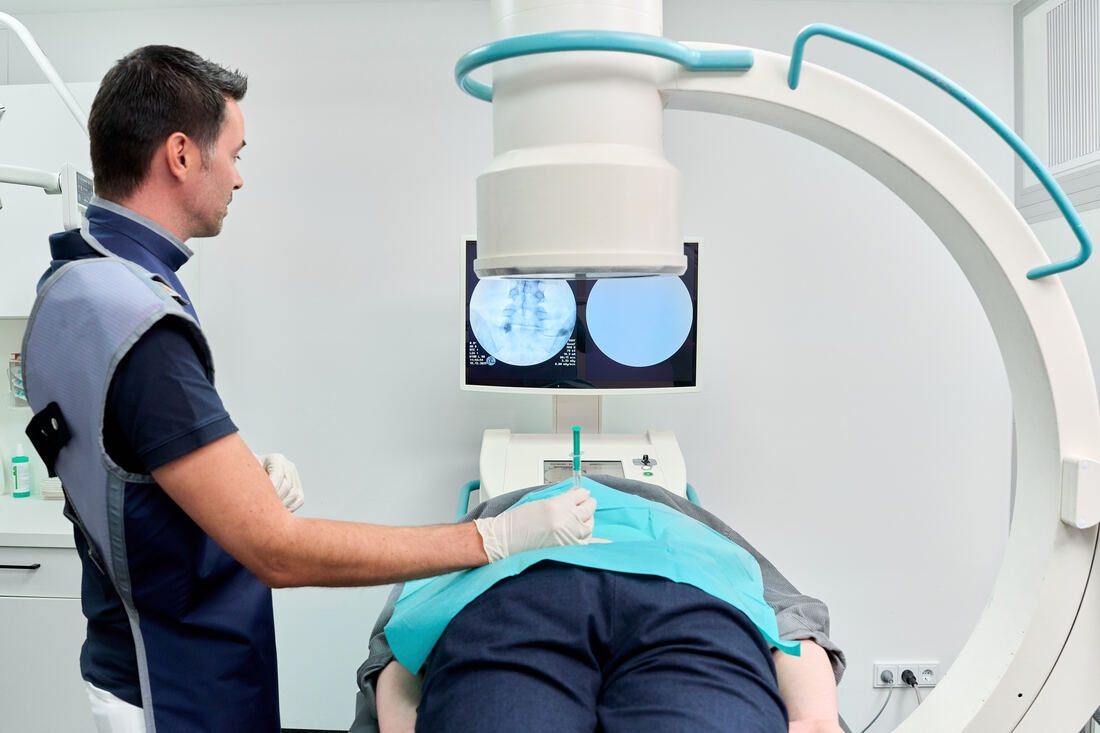
In endoscopic spine surgery , a herniated disc or narrowing at the nerve is treated through a thin working sleeve with a camera. Muscles and ligaments are not cut but only pushed aside. Endoscopic spine surgery is a specialty of our surgeons; operations are performed in our partner hospitals in Munich, Arabellaklinik/Herzogpark Klinik and Artemed Klinik München Süd.
At a glance
- Skin incision of about 8 millimetres
- For herniated discs in the lumbar and cervical spine and narrowing at the nerve exit
- Less tissue damage, less scarring, faster mobilisation
- Usually only a short hospital stay
- Surgery only after conservative therapy has been exhausted or in case of paralysis
How keyhole surgery works
- 1Skin incision approx. 8 mm
- 2Working sleeve with camera and instruments
- 3Herniated disc
- 4Decompressed nerve root
An endoscope with a high-resolution camera is inserted through the working sleeve. The surgeon sees the structures magnified on the screen and specifically removes the tissue that is compressing the nerve. Depending on the location of the herniation, we choose access from the side through the nerve exit foramen (transforaminal) or from behind between the vertebral arches (interlaminar). The operation is performed under general anaesthesia and usually takes 45 to 90 minutes.
Who is endoscopic surgery suitable for?
- Herniated disc with sciatica or arm pain that persists for weeks despite therapy
- Herniated disc with paralysis or sensory disturbance
- Narrowing of the nerve exit foramen or the lateral spinal canal (lateral recess stenosis)
- selected cases of Spinal stenosis
Limits: In the case of instability, marked spondylolisthesis or malalignment, endoscopic decompression alone is not enough. We then discuss other procedures such as microsurgical decompression or stabilisation.
Advantages over open surgery
| Endoscopic | Conventional open surgery | |
|---|---|---|
| Skin incision | approx. 8 mm | several centimetres |
| Muscles | is pushed aside | is detached |
| Mobilisation | usually on the day of surgery | on the day of or the day after surgery |
| Scar tissue at the nerve | minimal | more frequent |
Procedure and recovery
- Before surgeryMRI, examination, informed consent and planning at the practice.
- Day of surgeryProcedure under general anaesthesia, up and about a few hours later.
- First weeksWalking is explicitly encouraged; avoid prolonged sitting and lifting.
- After 2 to 6 weeksPhysiotherapy to strengthen the core muscles, return to work depending on your job.
Risks
Complications are rare. Possible complications include recurrent disc herniation at the same level (in a few percent of cases), temporary sensory disturbances, injury to the dura, bleeding or infection. We discuss your individual risk in detail before the procedure.
Frequently asked questions
- Is endoscopic disc surgery covered by statutory health insurance?
- Yes, when medically necessary, statutory and private health insurers cover the operation.
- How long will I be on sick leave after surgery?
- For office work often two to three weeks, for heavy physical work six weeks or longer.
- Can the herniated disc come back?
- Yes, in a few percent of cases. The risk is no higher with the endoscopic technique than with open surgery. Core training reduces it.
- Who will operate on me?
- Your doctor from the practice, who also examined you and provides your aftercare.
Your doctors for this topic


Updated: November 2026 · spectrum MED practice, Sendlinger Straße 37, Munich. This article does not replace a medical examination.