
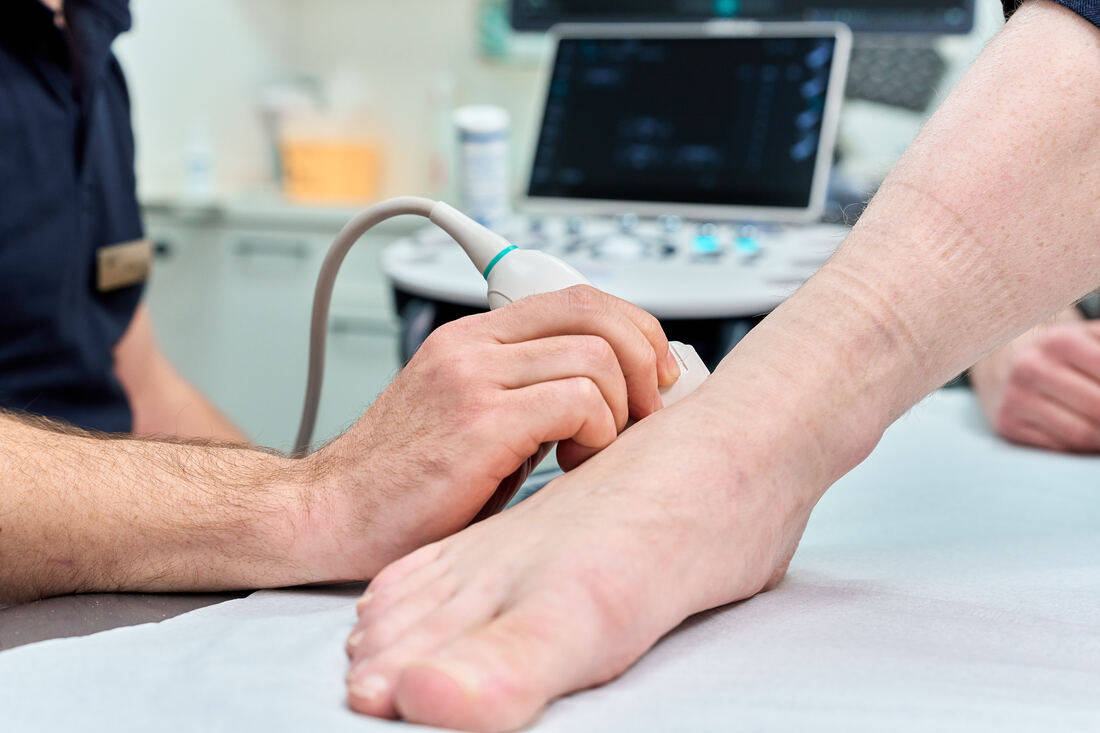
The term Pseudarthrosis ("false joint") is the term used when a fracture has not healed with bone even after six to nine months. Instead of solid bone, connective tissue forms between the fracture ends – the bone remains unstable and painful. The treatment of pseudarthrosis is a specialty of Priv.-Doz. Dr. Christoph Linhart.
At a glance
- Fracture not healed after six to nine months
- Typical: pain on loading, instability, implant loosening
- Causes: instability, blood supply, infection, smoking, metabolism
- Diagnostics with X-ray, CT and laboratory tests
- Treatment: shockwave, revision surgery, bone grafting
Normal healing and pseudarthrosis
- 1Callus bridges the fracture
- 2Gap with connective tissue – no bony union
A fracture normally heals in six to twelve weeks. This requires rest at the fracture site, good blood supply and sufficient biological activity. If one of these conditions is missing, healing may be delayed or fail altogether.
Causes
- Too much movement at the fracture site (insufficient stability)
- Poor blood supply, e.g. after severe soft tissue injuries
- Infection at the fracture site
- Smoking, diabetes, vitamin D deficiency, osteoporosis
- Certain medications and particularly vulnerable bones such as the scaphoid of the hand
Symptoms
- Persistent pain on loading months after the fracture
- Swelling, instability or abnormal mobility
- Loosening or breakage of screws and plates
Diagnosis
X-rays in several planes and computed tomography (CT) show whether the fracture is bridged by bone. Laboratory values help to detect infection or metabolic disorders. We distinguish between a "living" (hypertrophic) and a "biologically inactive" (atrophic) pseudarthrosis – treatment depends on this.
Treatment
- Eliminate causesStop smoking, treat vitamin D deficiency, metabolism and osteoporosis.
- Focused shockwavefor stable pseudarthroses, shockwave therapy can restart bone healing.
- Revision surgeryMore stable fixation with a plate or nail, removal of connective tissue.
- Bone graftingYour own bone, e.g. from the iliac crest, or bone substitute for biological stimulation.
Please bring: all X-ray and CT images since the accident, surgery reports and doctors' letters. This is the best way to assess the healing process.
Frequently asked questions
- When is it called a pseudarthrosis?
- When a fracture has not healed with bone after six to nine months despite treatment. Before that, it is called delayed bone healing.
- Does a pseudarthrosis heal on its own?
- Rarely. Targeted measures are usually needed – from shockwave to surgery.
- Is a pseudarthrosis after an accident at work a BG case?
- Yes, if the original fracture was an accident at work or on the way to work, the employers' liability insurance (BG) is responsible. More under Work accident.
Your doctors for this topic


Updated: November 2026 · spectrum MED practice, Sendlinger Straße 37, Munich. This article does not replace a medical examination.